
UAE AML Compliance in 2026: New Laws, goAML Registration and Key Business Requirements
Running a business in the UAE comes with opportunities, but it also means keeping up with the regulations that apply to your industry. One area businesses should not overlook is Anti-Money Laundering (AML) compliance.
The UAE introduced a new AML legal framework in 2025 to strengthen its efforts against financial crime and improve transparency across the business sector.
But what does this mean for your company? Does your business need to register on goAML? What are the reporting requirements, and what happens if you fail to comply?
Let’s take a closer look at the rules and what businesses need to know in 2026.
What Is Anti-Money Laundering (AML) and Why Does It Matter?
Imagine someone earns money through illegal activities and uses it to buy property, invest in a company or move funds through different bank accounts. The aim is to make that money look legitimate.
This process is known as money laundering.
AML regulations help prevent such activities by requiring businesses to verify customers, understand where funds come from, monitor transactions and report suspicious activity.
In the UAE, the regulatory framework covers three key areas:
- AML (Anti-Money Laundering): Prevents illegally obtained money from entering the legitimate financial system.
- CFT (Countering the Financing of Terrorism): Prevents funds from supporting terrorist activities.
- CPF (Countering Proliferation Financing): Prevents financial resources from supporting the development or acquisition of weapons of mass destruction.
Together, these measures help protect businesses, investors and the UAE’s financial system.
UAE Introduces a New AML Legal Framework in 2025
The UAE took an important step towards strengthening its financial crime prevention framework with Federal Decree-Law No. 10 of 2025.
The law came into effect on 14 October 2025 and replaced the previous Federal Decree-Law No. 20 of 2018.
The government followed it with Cabinet Resolution No. 134 of 2025, which introduced the new Executive Regulations and took effect on 14 December 2025. These regulations replaced Cabinet Resolution No. 10 of 2019.
So, what has changed for businesses?
The updated framework places greater emphasis on:
- Customer identification and verification.
- Customer Due Diligence (CDD) and Enhanced Due Diligence (EDD).
- Ultimate Beneficial Ownership (UBO).
- Suspicious transaction and activity reporting.
- Targeted Financial Sanctions (TFS).
- Money laundering, terrorist financing and proliferation financing risks.
It also gives greater attention to proliferation financing and the risks associated with virtual assets.
What businesses should pay attention to
Some important developments under the updated framework include:
- Proliferation financing now has a clearer and separate place within the legal framework.
- Commercial gaming operators fall under the DNFBP category when they meet the prescribed transaction threshold.
- Virtual Asset Service Providers (VASPs) have specific AML/CFT/CPF obligations.
- Businesses must maintain appropriate compliance arrangements, including risk assessments, customer checks and internal controls.
- The framework strengthens beneficial ownership transparency and reporting obligations.
- Authorities have powers to suspend suspicious transactions and take action against suspected financial crime.
The important point is that AML compliance should not be treated as occasional paperwork. Businesses need to make it part of their everyday operations.
What Is goAML in the UAE?
If you have come across the term goAML, you may be wondering what it actually does.
goAML is a secure financial intelligence reporting system developed by the United Nations Office on Drugs and Crime (UNODC). The UAE Financial Intelligence Unit (FIU) uses it to receive and analyse reports about suspicious financial activities.
In simple terms, it gives regulated businesses a formal channel to report transactions or activities that may involve financial crime.
The FIU reviews these reports and shares relevant financial intelligence with the competent authorities when necessary.
Is goAML Registration Mandatory in the UAE?
Yes, if your business falls under the applicable reporting requirements.
Financial institutions, Designated Non-Financial Businesses and Professions (DNFBPs), and Virtual Asset Service Providers (VASPs) must follow the registration and reporting requirements that apply to their sector.
The registration process generally involves two stages:
- Pre-registration on SACM: The organisation submits its initial registration request through the relevant system.
- Registration on goAML: After the supervisory authority approves the pre-registration, the organisation completes the goAML registration process.
The relevant supervisory authority reviews and approves the registration.
However, registering on goAML is only the first step. Businesses must also maintain appropriate AML policies, assess customer risks, monitor transactions and report suspicious activities when required.
You can access the official portals here:
- UAE Ministry of Economy and Tourism – goAML Registration Guidance
- UAE Financial Intelligence Unit – goAML Portal
Which Businesses Must Register on goAML?
Not every company in the UAE automatically falls under the DNFBP category. The requirement depends on the nature of its activities and the applicable legal definitions.
However, the AML framework specifically covers several industries.
1. Real Estate Agents and Brokers
Property transactions often involve substantial amounts of money. Therefore, real estate agents and brokers who conclude property purchases or sales on behalf of customers must follow the applicable AML requirements.
2. Dealers in Precious Metals and Stones (DPMS)
This category includes businesses dealing in gold, silver, platinum, diamonds and other precious stones.
Jewellery retailers and gold traders must pay particular attention to customer verification and transaction reporting. For example, qualifying transactions involving AED 55,000 or more may trigger DPMS reporting requirements, depending on the customer type and payment method.
3. Accountants and Auditors
Independent accountants and auditors fall under the AML framework when they carry out specified activities on behalf of customers.
These activities include managing client funds, handling financial accounts, organising company formation contributions, and buying or selling businesses or real estate.
4. Corporate and Trust Service Providers
Corporate service providers may fall under DNFBP requirements when they perform certain activities for customers.
These include:
- Acting as a company formation agent.
- Providing directors, secretaries or partners.
- Offering registered office or business address services.
- Acting as a trustee of an express trust.
- Arranging nominee shareholders.
5. Legal Professionals and Notaries
Lawyers, legal consultants and notaries may also fall under the AML framework when they carry out specified activities involving property transactions, financial arrangements, company formation or client funds.
6. Virtual Asset Service Providers (VASPs)
Businesses providing virtual asset services from within the UAE must follow the licensing and AML/CFT/CPF requirements of their competent authority.
This includes applicable obligations relating to customer verification, transaction monitoring and suspicious activity reporting.
7. Commercial Gaming Operators
The new Executive Regulations also include commercial gaming operators, including gaming activities conducted on vessels and marine craft.
The category applies when a single financial transaction, or several transactions that appear connected, reaches AED 11,000 or more. Transactions involving only gaming chips or gaming instruments do not count towards this threshold.
Who supervises these businesses?
The relevant supervisory authority depends on the business activity and jurisdiction.
For example, the Ministry of Economy and Tourism supervises relevant DNFBPs within its remit, including real estate brokers, dealers in precious metals and stones, accountants, auditors and corporate service providers.
Meanwhile, DIFC and ADGM entities fall under their respective regulatory frameworks, while legal professionals, VASPs and commercial gaming operators have their applicable competent authorities.
Important: A company’s trade licence name alone does not determine whether it needs to register. Its actual business activities matter.
Important AML Reporting Requirements Businesses Should Know
Registering on goAML does not complete a business’s AML obligations. Companies must also understand when they need to report certain transactions and suspicious activities.
Here are four important reporting areas.
A. Dealers in Precious Metals and Stones (DPMSR)
Dealers in Precious Metals and Stones must pay close attention to transactions involving AED 55,000 or more.
Under the applicable FIU reporting guidance, DPMSR requirements cover qualifying transactions, including:
- Cash transactions of AED 55,000 or more involving resident or non-resident individuals.
- Qualifying transactions of AED 55,000 or more involving companies or other legal entities, subject to the applicable payment and reporting criteria.
Businesses must collect the required customer and transaction information and submit the relevant report through goAML.
One important distinction: DPMSR reporting is not limited to suspicious transactions. A qualifying transaction may require reporting even when the business has no reason to suspect financial crime.
However, if a transaction raises suspicion, the business must consider its separate suspicious transaction reporting obligation regardless of the transaction value.
B. Real Estate Activity Reporting (REAR)
Real estate agents and brokers must also understand the Real Estate Activity Report (REAR) requirements.
The reporting rules cover certain freehold property purchases and sales where the payment involves:
- Cash payments of AED 55,000 or more, whether made in one payment or several payments.
- Virtual assets used to pay for part or all of the property.
- Funds converted from or into virtual assets to complete a property transaction.
These reports help authorities identify potential attempts to use property transactions to hide the source of funds.
Like DPMSR, REAR reporting applies to qualifying transactions and does not depend on whether the broker suspects wrongdoing.
C. Suspicious Transaction Reporting (STR)
What should a business do when a transaction does not seem right?
If a business knows, suspects or has reasonable grounds to suspect that a transaction or attempted transaction relates to money laundering, terrorist financing, proliferation financing or another relevant financial crime, it must report the matter to the FIU without delay.
The business must submit the appropriate Suspicious Transaction Report (STR) or Suspicious Activity Report (SAR), as applicable, through goAML.
There is no minimum transaction value for reporting genuine suspicion. Therefore, businesses should not wait until they have proof of wrongdoing before escalating a concern.
They must also avoid informing customers that they have filed a suspicious transaction report. This is known as tipping off, and the law prohibits it.
D. Targeted Financial Sanctions (TFS)
Businesses must screen relevant customers and other parties against applicable UAE Local Terrorist Lists and United Nations Security Council sanctions lists.
If a business identifies a confirmed sanctions match, it must take the required freezing and prohibition measures without delay and submit the relevant report through goAML.
Businesses should also follow applicable procedures for potential matches and use the EOCN Notification Alert System where required.
Sanctions screening should not happen only when a customer first joins the business. Companies should also review relevant parties against updated sanctions lists as part of their ongoing compliance procedures.
Customer Due Diligence (CDD) and Enhanced Due Diligence (EDD): What’s the Difference?
Knowing who your customers are is one of the most important parts of AML compliance.
This process is called Customer Due Diligence (CDD).
When a business starts a relationship with a customer, it must take reasonable steps to verify the customer’s identity, understand their activities and identify the people who ultimately own or control the business.
CDD generally involves:
- Verifying the customer’s identity.
- Understanding the customer’s business activities.
- Identifying the Ultimate Beneficial Owner.
- Understanding the purpose of the business relationship.
- Checking the source of funds where required.
- Monitoring transactions for unusual activity.
Businesses must also revisit CDD when they suspect financial crime or have doubts about previously collected customer information.
When Does a Business Need Enhanced Due Diligence?
Some customers and transactions carry a higher level of risk. In such cases, standard customer checks may not be enough.
This is where Enhanced Due Diligence (EDD) comes in.
EDD involves additional checks to understand and manage higher-risk relationships.
For example, businesses may need to apply EDD when dealing with:
- Politically Exposed Persons (PEPs), their immediate family members and close associates.
- Customers connected with high-risk jurisdictions.
- Complicated ownership structures.
- Transactions that do not match the customer’s known business profile.
These additional checks may include collecting more information about the customer, verifying the source of funds and wealth, conducting closer transaction monitoring and obtaining senior management approval where required.
The objective is simple: understand the risk before it becomes a bigger problem.
What if a business cannot complete CDD?
A business should not simply proceed with the transaction or relationship.
Where it cannot complete the required CDD measures, it must not establish or continue the business relationship or carry out the transaction, and it should consider whether it needs to submit a suspicious transaction report.
Why Is Ultimate Beneficial Ownership (UBO) Important?
Do you know who actually owns or controls your company?
In some businesses, the person listed as a shareholder may not be the individual who ultimately controls the company or benefits from its activities.
This is why identifying the Ultimate Beneficial Owner (UBO) is an important part of the UAE’s transparency requirements.
A UBO is the natural person who ultimately owns or exercises effective control over a legal entity.
The identification process generally follows these steps:
- Identify any individual who directly or indirectly owns 25% or more of the company’s shares or ownership interest.
- If no individual meets this threshold, or there is doubt about the person identified, look at who exercises effective control through other means.
- If the business cannot identify an individual through these tests, identify the relevant senior management person in accordance with the applicable rules.
Companies must maintain accurate and up-to-date beneficial ownership records. They must also notify the relevant authorities of changes within the prescribed time limits.
Nominee directors and shareholders must follow the applicable disclosure requirements as well.
Proper UBO records help authorities understand who stands behind a business and make it harder for individuals to hide financial crime through complicated ownership structures.
What Are the Penalties for AML Non-Compliance in the UAE?
AML compliance is a legal responsibility, and ignoring it can have serious consequences.
The UAE authorities can take administrative action against businesses that fail to meet their obligations. Depending on the nature and seriousness of the violation, penalties may include:
- Official warnings.
- Administrative fines that can reach AED 5 million per violation under the applicable framework.
- Restrictions on certain business activities.
- Restrictions on the powers of responsible managers or executives.
- Suspension of business activities or professional licences.
- Replacement or suspension of responsible directors and executives, where applicable.
Repeated violations can lead to further consequences.
The situation becomes even more serious when a business or individual commits an actual money laundering, terrorist financing or proliferation financing offence. Separate criminal penalties may apply, including imprisonment and substantial fines.
For legal persons, the law also provides for significant corporate fines where the relevant offences occur on their behalf through their representatives, directors or agents.
The exact penalty depends on the offence, the circumstances and the applicable legal provisions.
UAE AML Inspection Results: A Closer Look at 2025
The UAE Ministry of Economy and Tourism’s inspection results for the first half of 2025 show why businesses need to take compliance seriously.
The Ministry identified 1,063 AML compliance violations and imposed fines exceeding AED 42 million on non-compliant DNFBPs.
The reported results included:
- Precious metals and stones traders: 473 violations, resulting in AED 20 million in fines.
- Real estate brokerages: 495 violations, resulting in AED 18.5 million in fines.
- Corporate service providers and auditors: 95 penalties, amounting to more than AED 4 million.
The Ministry also highlighted its use of desk-based reviews and targeted field inspections to identify compliance gaps.
For businesses, the message is clear: regulators are actively checking compliance, and companies need to keep their records, procedures and reporting arrangements in order.
How Can Businesses Prepare for AML Compliance in 2026?
Understanding the regulations is one thing. Putting them into practice is what really matters.
Whether you operate a real estate agency, jewellery business, accounting firm or corporate service company, a proper AML compliance process can help you manage risks and meet your obligations.
Here are ten practical steps to consider:
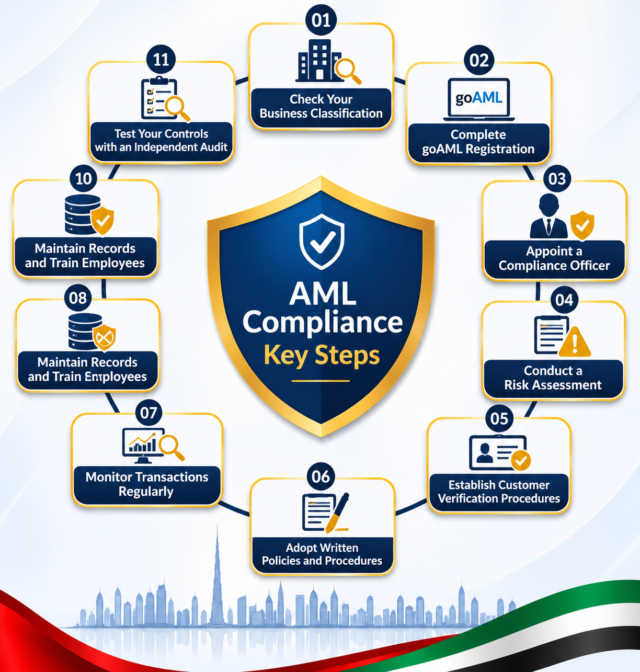
Remember, AML compliance is an ongoing responsibility. A business should review its procedures regularly rather than waiting for an inspection or regulatory notice.
How Arthshashtri Can Help Your Business
Keeping up with UAE regulations can be challenging, especially when a business is trying to manage daily operations at the same time.
AML compliance involves more than registering on goAML. Businesses also need to understand which rules apply to them, maintain proper records and establish processes that meet their regulatory obligations.
At Arthshashtri Corporate Services LLC, we help businesses understand their UAE compliance responsibilities and identify the steps they need to take.
Our team can assist with understanding applicable AML requirements, goAML registration guidance and related corporate compliance needs.
Whether you are setting up a new business or reviewing your existing compliance arrangements, getting the right guidance can make the process easier.
Need help understanding your AML obligations in the UAE? Get in touch with Arthshashtri Corporate Services and speak with our team about your business requirements.
Disclaimer: This article is for general information only and does not constitute tax or legal advice. The application of UAE VAT legislation depends on the facts of each transaction and the relevant legal provisions. Businesses should consult a qualified tax professional for advice specific to their circumstances.