
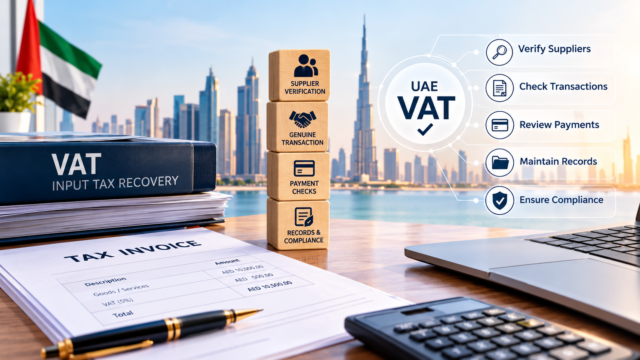
A tax invoice may look perfectly fine. But is that enough to recover the VAT you paid to your supplier?
From 1 October 2026, UAE businesses must follow additional procedures to verify their suppliers and the supplies they receive before recovering input VAT. These requirements are introduced under Federal Tax Authority (FTA) Decision No. 13 of 2026.
This means businesses need to look beyond invoices. They must also check who they are buying from, whether the transaction is genuine and whether their records support the VAT claim.
Why Are the New VAT Rules Important?
Businesses registered for VAT can generally recover eligible VAT paid on business purchases, provided the legal conditions are met.
However, problems can arise when a supplier is involved in tax evasion or a transaction cannot be properly verified.
Under the amended UAE VAT law, the FTA can deny input tax recovery in certain cases where a business knew or should have known that its supply was connected to tax evasion.
In simple terms, businesses need to take reasonable steps to check their suppliers and purchases instead of relying only on the tax invoice.
1. Check Your Supplier Before Doing Business
Before working with a new supplier, businesses must verify the supplier’s identity and relevant business details.
For a company, this includes checking its incorporation details and verifying the identity of the person authorised to represent it.
Businesses must also check that the supplier has a genuine place of business and that the premises are suitable for the activities being carried out.
For an individual supplier, the rules include checking valid identification and meeting the supplier in person or virtually before the supply takes place.
These checks are required when dealing with a supplier for the first time. They must also be repeated for existing suppliers who have not been verified during the previous 12 months.
2. Make Sure the Transaction Is Genuine
A valid invoice does not, by itself, establish that a transaction is genuine.
Businesses should check whether the purchase has a clear commercial purpose and whether the supplier’s involvement makes sense.
For example, if a company purchases IT equipment, it should be able to explain why the equipment was needed and keep supporting records of the purchase and delivery.
The price should also be commercially reasonable. If a supplier offers goods at a price significantly different from the market rate, the business should investigate the reason.
Businesses must also check whether the goods or services supplied match the supplier’s normal business activities and licensed activities.
3. Pay Attention to Payment Methods
The new verification rules also require businesses to review how suppliers are paid.
Electronic payments are generally preferred because they create a clear transaction trail.
If a payment is made to a third party or to a bank account outside the supplier’s country of incorporation, there should be a reasonable commercial explanation.
Cash payments also require attention. Cabinet Decision No. 149 of 2026 introduces a restriction on recovering input VAT for certain supplies paid, or intended to be paid, in cash.
The monetary threshold and detailed conditions for this restriction are to be specified through a separate Ministerial Decision. Businesses should monitor official updates rather than assume that a particular cash limit already applies.
United Arab Emirates +1
4. When Are Additional Supplier Checks Required?
The verification requirements depend on the supplier, the transaction and the value of supplies received.
For supplies worth less than AED 10,000, excluding VAT, certain verification measures may be disregarded. However, this exception does not apply if the total value of supplies from the same supplier exceeds, or is expected to exceed, AED 100,000 over a 12-month period.
Additional checks apply when supplies from a supplier exceed, or are expected to exceed, AED 375,000 over 12 months. These include obtaining written confirmation from an authorised UAE bank that the supplier has a bank account and reviewing relevant publicly available information and media coverage.
These thresholds are part of the prescribed verification rules. They should not be treated as a general exemption from the other conditions for recovering input VAT.
5. Keep Records That Support Your VAT Claims
Supplier verification should not be an informal exercise. Businesses must document the checks they carry out and retain supporting evidence.
Your finance team should maintain records such as:
- Supplier registration and identity documents.
- Evidence of the supplier’s business address.
- Purchase orders, contracts and valid tax invoices.
- Delivery notes or other proof that goods or services were received.
- Payment records and explanations for unusual payment arrangements.
- Notes of supplier verification and risk assessments.
Businesses must also maintain a written policy identifying who is responsible for performing, reviewing and supervising these checks.
Keeping these records organised can help your team respond more efficiently if the FTA asks for evidence during an audit.
6. Review Your Existing VAT and Refund Processes
Supplier verification is not the only VAT change businesses need to consider.
Federal Decree-Law No. 16 of 2025 introduced changes to the UAE VAT framework, including a five-year time limit relating to excess recoverable input tax balances and refund claims, subject to the applicable legal conditions and exceptions.
Businesses should review outstanding VAT credit balances, reconcile their records and check the applicable deadlines rather than allowing old balances to remain unresolved.
Cabinet Decision No. 149 of 2026 also amends several provisions of the VAT Executive Regulation. Most changes took effect on 1 October 2026, while certain changes to input tax apportionment apply from the first tax year commencing after 1 October 2027.
Finance teams should review which provisions affect their business and update their accounting procedures accordingly.
What Should UAE Businesses Do Now?
You do not need to make supplier verification unnecessarily complicated. Start by reviewing your current procurement and accounts payable processes.
Here are five practical steps to take:
- Review your supplier onboarding checklist and include the required identity and business verification steps.
- Recheck existing suppliers who have not been verified in the previous 12 months.
- Ensure each purchase has a clear commercial purpose and supporting documentation.
- Review payment arrangements, particularly cash payments and payments involving third parties.
- Create a written verification policy and maintain a clear audit trail for your VAT claims.
The goal is to make compliance part of your normal purchasing process rather than something your team handles only when an audit takes place.
How Arthshashtri Can Help
Keeping up with changing UAE tax regulations can be challenging, particularly when your finance team is managing supplier payments, VAT returns and day-to-day accounting at the same time.
Arthshashtri Corporate Services LLC helps businesses understand their tax and compliance responsibilities, review their accounting processes and organise the documentation needed to support their VAT positions.
Our experts can help you assess how the new supplier-verification requirements may affect your business and identify practical steps to improve your compliance process.
Have questions about the new UAE VAT rules? Contact Arthshashtri to discuss your business requirements and get guidance from our team.
Disclaimer: This article is for general information only and does not constitute tax or legal advice. The application of UAE VAT legislation depends on the facts of each transaction and the relevant legal provisions. Businesses should consult a qualified tax professional for advice specific to their circumstances.